"In
short, in developed markets, the reality is that we live in a multi-screen
world, not a "mobile world" that operates
parallel to a "desktop world."
Henry
Blodgett, Business Insider
December
22, 2012
http://www.businessinsider.com/survey-mobile-first-bad-strategy-2012-12
Henry
Blodgett succinctly clarifies "the reality" regarding mobile media
with his reference to a "multi-screen world." This world
includes mobile media, but mobile media is not the center of it. The
dispersal factor of the internet insures that there is no center in
communication, except the individuals, and groups of people who are
communicating. Communicators are the ones juggling the multiple screens
that make up modern communications. Real world jugglers have been known
to juggle everything from harmless balls to swords. The ability to juggle
the creation of multimedia content and managing/leading the dissemination of
that content across multiple platforms/screens - these are the essential skills
for strategic communicator leaders today, particularly for those communicators
whose focus is developed countries. The needs of developing countries are more
complex, because of the DIGITAL DIVIDE.
"The “Digital Divide” is defined as
the gap between those with regular, effective access and ability to use digital
technologies and those without. An important step in the direction of filling
this gap has been the deployment of mobile networks all around the world. For
example, as of today, more than 80% of the World's population is covered by
GSM, and more than 2.4 billions of people have access to a mobile phone (Source
[1]). With one million additional people newly subscribed every day, it is
expected that by the end of 2010, almost 4 billions will have access to mobile
phones. While accessing phone services is very important, the gap will be more
completely filled when access to a higher level of information technologies
will be widespread".
Stéphane
BOYERA
https://www.w3.org/2006/12/digital_divide/IST-africa-final.pdf
Jugglers are often seen in circus acts, and they invoke awe in
their ability to do what they do. Strategic Communicators will likewise find it
quite a feat to juggle the many responsibilities involved in communicating in a
multi-screen world.
Seeing ourselves are jugglers can help us conceptualize
ourselves and our work, so that we understand the complexity, yet know that
there is a method to the seeming madness. Again, by tapping into social
science research to better understand our markets, by spending the appropriate
amount of time and energy to become knowledgeable about mobile technology, and
a similar amount of time understanding emerging media in its entirety - by
doing these three things, juggling them as a juggler would juggle his juggling
balls, we increase the likelihood that we will be successful in our navigation
of emerging media in a multi-screen world.
Our professor for the Strategic
Communications, Emerging Media class, Dr. Steven Padgett, points out to us that
"mobile technologies are changing the way people seek information. Some of
these changes are positive, some are not. Mobile
Mobile communication is centered around
cell phones and smart phones. Smart phones are all cell phones, but not
all cell phones are smart phones. My first cell phone was a flip phone
that I used only for making phone calls. Long after texting became
available on a cell phone, I declined to try it. Even today, I don’t care
for texting and only text occasionally. I prefer to actually speak to a
person. I have seen many times when miscommunication occurred because a
text was misinterpreted. A simple phone call would have eliminated the
confusion. However, at other times, a text can provide more accuracy, for
example, when the correct spelling of something is important.
Strategic Communications professionals
must learn to juggle many balls. I bought a set of three juggling balls
about a year ago. They have been resting on a shelf since then.
Tonight, I took them out and worked with two out of the set of three.
I found it quite easy to do this. So now, I think is a good time to
begin to practice the art of juggling, by taking time each day to get better.
Practice, as the saying goes, makes perfect. Five minutes a day
should, in a month produce improvement. In fact, I expect to incorporate
the third ball into my amateur juggling act within two weeks. 30 days X 5
minutes a day will produce 150 minutes of practice, a full 2.5 hours. My
first day is today, the day of this posting, January 27, 2017. I will
keep you informed as the weeks roll on about the progress of my juggling.
Similarly, strategic communications
professionals must practice working with mobile applications in order to better
understand them, and become adept at working with them. I have to admit
that I have an I Phone 3. This phone serves my needs in most areas, but
in the area of mobile apps the phone is completely out of date. I cannot
download the latest apps because the phone does not support them. I have
come to realize that in order for me to use the many new mobile apps I will
need a newer phone. This brings me to the point I want to make in my post
this week. Each of us lives in a unique environment. While many
apps transcend space, meaning they are useful no matter where you are, there
are many apps that are issued for a specific grounded, location based business.
The Troy
University radio station WTSU,
operates in the Troy , Alabama
radio market with expanded coverage into Montgomery
and Dothan Alabama
Strategic communications professionals can
use mobile media in a variety of ways, but that is determined by the nature of
the business the professional is working for. Some businesses have a
clientele, a demographic, and a business base that uses mobile. Other
businesses may not have a customer base that is into mobile as much. So
each professional has to size up the business environment, check the pertinent
data, and do research, using research skills taught at the Master's Degree
level. The research into the potential uses for mobile media will yield
information that can be used to decide the best use of mobile media for a
particular business.
Research will examine the demographic, and
might include surveying. In addition, the current trends can be examined
to see where things are going with mobile media.
Ethical decisions are important.
Using mobile media should follow the same ethical guidelines as any other
communication.
Strategic communicators will have to
juggle several activities at once. Mobile media is just one area. Mobile
The skilled juggler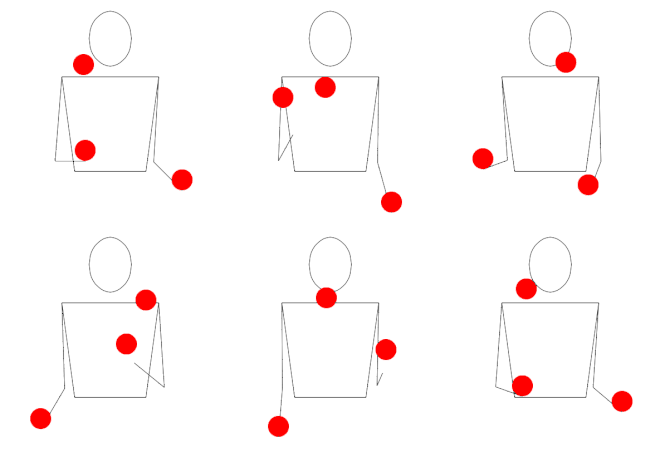
is able to keep many things going at once.
The skilled strategic communicator can do the same. Mobile media,
then, can be one ball of many (one of many other communication strategies, such
as print, TV, radio, etc, or it can be all the balls, but segmented, with each
ball a different mobile media strategy (such as mobile apps, mobile internet,
or SMS). The key is to get them all going and keep them in the air, no
small feat, but easier for the skilled strategic communication juggler.
http://www.juggglow.com/en/
Juggglow
combines
the art of juggling with mobile technology by connecting your smartphone to the
juggling balls via Bluetooth Smart. You can control the color effects of the
glowing balls and share your juggling achievements with your friends. The
mobile app includes many more features such as games, battles, statistics and
tutorials.
The above juggling app shows how there is
a mobile application for nearly every activity. Therein lays the
opportunity for expansion into mobile. Motion = mobile. Motion is
everything, and people, even when sitting still, are still in motion with their
mobile phone. Like the juggler's ball, motion is constant. Mobile
media, because you can take it anywhere, means that anything can be done with a
mobile device. The possibilities are nearly endless.
So how can strategic communication
professionals efficiently and ethically use mobile media? One way is to
learn the art of juggling. Multitasking means being able to do many
things at once. Mobile
Efficient, ethical behavior for strategic
communicators when using the tool of mobile technology to advance their careers
is a worthy goal for each of us to strive for. Ethics is important when
it comes to equity. We in affluent countries of the West often take our
access to technology for granted, including mobile technology. Ethical behavior for strategic communicators will include concern for equal access to emerging media and mobile technology for rural America, the poor in America, and developing countries.
BELOW IS THE LIST OF TITLES AND LINKS TO READINGS
The mobile Web to bridge the
digital divide?
http://www.w3.org/2006/12/digital_divide/IST-africa-final.pdf
http://www.w3.org/2006/12/digital_divide/IST-africa-final.pdf
If you love something, let it
go mobile
http://www.slideshare.net/mobmarguru/mobile-marketing-and-mobile-social-media
http://www.slideshare.net/mobmarguru/mobile-marketing-and-mobile-social-media
The sites benefiting from
mobile
http://www.businessinsider.com/chart-of-the-day-mobile-audience-for-sites-2013-2
http://www.businessinsider.com/chart-of-the-day-mobile-audience-for-sites-2013-2
The anthropology of mobile
phones (This is a TED Talk video)
http://www.ted.com/talks/jan_chipchase_on_our_mobile_phones.html
http://www.ted.com/talks/jan_chipchase_on_our_mobile_phones.html
The politics of platforms
http://web.mit.edu/comm-forum/mit6/papers/Gillespie.pdf
http://web.mit.edu/comm-forum/mit6/papers/Gillespie.pdf
Shape of phones (This is a short and strange
TED Talk about the possibilities of altering the physical shape of a mobile
phone.)
http://www.ted.com/talks/fabian_hemmert_the_shape_shifting_future_of_the_mobile_phone.html
http://www.ted.com/talks/fabian_hemmert_the_shape_shifting_future_of_the_mobile_phone.html
The mobile phone and the public
spheres
https://wiki.doit.wisc.edu/confluence/download/attachments/19300391/gordon_2007.pdf?version=2
https://wiki.doit.wisc.edu/confluence/download/attachments/19300391/gordon_2007.pdf?version=2
iPad adoption is growing like
crazy
http://www.businessinsider.com/chart-of-the-day-ipad-sales-in-context-2012-12
http://www.businessinsider.com/chart-of-the-day-ipad-sales-in-context-2012-12
We are working hard to get out
of paper ads
http://newsosaur.blogspot.com/2013/03/were-working-hard-to-get-out-of-paper.html
http://newsosaur.blogspot.com/2013/03/were-working-hard-to-get-out-of-paper.html


This is a picture of me, Eulas Kirtdoll, speaking to a community group in Marion, Alabama, May, 2015

No comments:
Post a Comment