Friday, January 27, 2017

- Juggling Mobile Tech with Emerging Media in a Multi-Screen World

"In short, in developed markets, the reality is that we live in a multi-screen world, not a "mobile world" that operates parallel to a "desktop world."
Henry Blodgett, Business Insider
 December 22, 2012
http://www.businessinsider.com/survey-mobile-first-bad-strategy-2012-12

Henry Blodgett succinctly clarifies "the reality" regarding mobile media with his reference to a "multi-screen world."  This world includes mobile media, but mobile media is not the center of it.  The dispersal factor of the internet insures that there is no center in communication, except the individuals, and groups of people who are communicating.  Communicators are the ones juggling the multiple screens that make up modern communications.  Real world jugglers have been known to juggle everything from harmless balls to swords.  The ability to juggle the creation of multimedia content and managing/leading the dissemination of that content across multiple platforms/screens - these are the essential skills for strategic communicator leaders today, particularly for those communicators whose focus is developed countries. The needs of developing countries are more complex, because of the DIGITAL DIVIDE.

"The “Digital Divide” is defined as the gap between those with regular, effective access and ability to use digital technologies and those without. An important step in the direction of filling this gap has been the deployment of mobile networks all around the world. For example, as of today, more than 80% of the World's population is covered by GSM, and more than 2.4 billions of people have access to a mobile phone (Source [1]). With one million additional people newly subscribed every day, it is expected that by the end of 2010, almost 4 billions will have access to mobile phones. While accessing phone services is very important, the gap will be more completely filled when access to a higher level of information technologies will be widespread".
Stéphane BOYERA
https://www.w3.org/2006/12/digital_divide/IST-africa-final.pdf

Jugglers are often seen in circus acts, and they invoke awe in their ability to do what they do. Strategic Communicators will likewise find it quite a feat to juggle the many responsibilities involved in communicating in a multi-screen world.

Seeing ourselves are jugglers can help us conceptualize ourselves and our work, so that we understand the complexity, yet know that there is a method to the seeming madness.  Again, by tapping into social science research to better understand our markets, by spending the appropriate amount of time and energy to become knowledgeable about mobile technology, and a similar amount of time understanding emerging media in its entirety - by doing these three things, juggling them as a juggler would juggle his juggling balls, we increase the likelihood that we will be successful in our navigation of emerging media in a multi-screen world.


Our professor for the Strategic Communications, Emerging Media class, Dr. Steven Padgett, points out to us that "mobile technologies are changing the way people seek information. Some of these changes are positive, some are not. Mobile fits as an emerging media."  He then asks us "how can strategic communication professionals use this tool in an efficient and ethical manner?"  

Mobile communication is centered around cell phones and smart phones.  Smart phones are all cell phones, but not all cell phones are smart phones.  My first cell phone was a flip phone that I used only for making phone calls.  Long after texting became available on a cell phone, I declined to try it.  Even today, I don’t care for texting and only text occasionally.  I prefer to actually speak to a person.  I have seen many times when miscommunication occurred because a text was misinterpreted.  A simple phone call would have eliminated the confusion.  However, at other times, a text can provide more accuracy, for example, when the correct spelling of something is important.

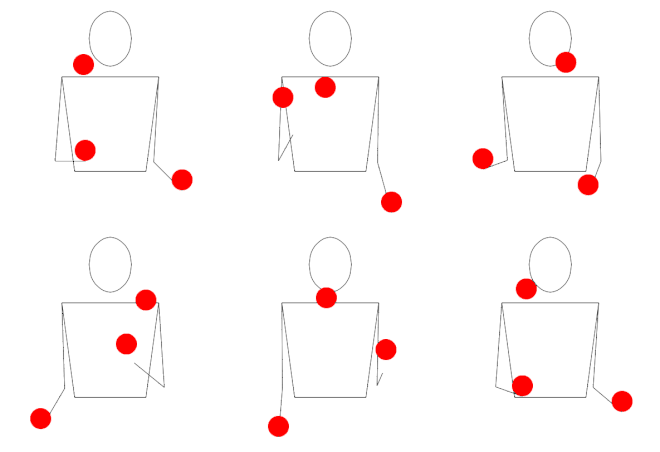
Strategic Communications professionals must learn to juggle many balls.  I bought a set of three juggling balls about a year ago.  They have been resting on a shelf since then.  Tonight, I took them out and worked with two out of the set of three.  I found it quite easy to do this.  So now, I think is a good time to begin to practice the art of juggling, by taking time each day to get better.  Practice, as the saying goes, makes perfect.  Five minutes a day should, in a month produce improvement.  In fact, I expect to incorporate the third ball into my amateur juggling act within two weeks.  30 days X 5 minutes a day will produce 150 minutes of practice, a full 2.5 hours.  My first day is today, the day of this posting, January 27, 2017.  I will keep you informed as the weeks roll on about the progress of my juggling.

Similarly, strategic communications professionals must practice working with mobile applications in order to better understand them, and become adept at working with them.  I have to admit that I have an I Phone 3.  This phone serves my needs in most areas, but in the area of mobile apps the phone is completely out of date.  I cannot download the latest apps because the phone does not support them.  I have come to realize that in order for me to use the many new mobile apps I will need a newer phone.  This brings me to the point I want to make in my post this week.  Each of us lives in a unique environment.  While many apps transcend space, meaning they are useful no matter where you are, there are many apps that are issued for a specific grounded, location based business.

The Troy University radio station WTSU, operates in the Troy, Alabama radio market with expanded coverage into Montgomery and Dothan Alabama.  WTSU does not have a mobile app.  However, radio apps like Tunein allow one to listen to 100,000 radio station, including WTSU, so having it own app is not critical for listening to the station.  However, mobile apps provide other capabilities besides listening.  It is the individuality and uniqueness that a dedicated app brings to a radio station like WTSU.  However, there is a cost associated with almost everything.  Public radio, because of its non profit structure, does not have the flexibility that for profit radio stations have.

Strategic communications professionals can use mobile media in a variety of ways, but that is determined by the nature of the business the professional is working for.  Some businesses have a clientele, a demographic, and a business base that uses mobile.  Other businesses may not have a customer base that is into mobile as much.  So each professional has to size up the business environment, check the pertinent data, and do research, using research skills taught at the Master's Degree level.  The research into the potential uses for mobile media will yield information that can be used to decide the best use of mobile media for a particular business.

Research will examine the demographic, and might include surveying.  In addition, the current trends can be examined to see where things are going with mobile media.
Ethical decisions are important.  Using mobile media should follow the same ethical guidelines as any other communication.


Strategic communicators will have to juggle several activities at once.  Mobile media is just one area.  Mobile first may be practical for some businesses, but the business plan that is mobile only is only appropriate for certain businesses.  Even then, decisions must be made to stay out in front on the mobile platform.  Competition is fierce in the mobile arena, and mistakes can be deadly to a business.
The skilled juggler
is able to keep many things going at once.  The skilled strategic communicator can do the same.  Mobile media, then, can be one ball of many (one of many other communication strategies, such as print, TV, radio, etc, or it can be all the balls, but segmented, with each ball a different mobile media strategy (such as mobile apps, mobile internet, or SMS).  The key is to get them all going and keep them in the air, no small feat, but easier for the skilled strategic communication juggler.


http://www.juggglow.com/en/

Juggglow

combines the art of juggling with mobile technology by connecting your smartphone to the juggling balls via Bluetooth Smart. You can control the color effects of the glowing balls and share your juggling achievements with your friends. The mobile app includes many more features such as games, battles, statistics and tutorials.


The above juggling app shows how there is a mobile application for nearly every activity.  Therein lays the opportunity for expansion into mobile.  Motion = mobile.  Motion is everything, and people, even when sitting still, are still in motion with their mobile phone.  Like the juggler's ball, motion is constant.  Mobile media, because you can take it anywhere, means that anything can be done with a mobile device.  The possibilities are nearly endless.  

So how can strategic communication professionals efficiently and ethically use mobile media?  One way is to learn the art of juggling.  Multitasking means being able to do many things at once.  Mobile implies motion.  Think motion, and how skillfully and ethically managing moving parts will enable efficiency in mobile media.


Efficient, ethical behavior for strategic communicators when using the tool of mobile technology to advance their careers is a worthy goal for each of us to strive for.  Ethics is important when it comes to equity.  We in affluent countries of the West often take our access to technology for granted, including mobile technology.  Ethical behavior for strategic communicators will include concern for equal access to emerging media and mobile technology for rural America, the poor in America, and developing countries.

BELOW IS THE LIST OF TITLES AND LINKS TO READINGS FOR OUR CLASS THIS WEEK:

The mobile Web to bridge the digital divide?
http://www.w3.org/2006/12/digital_divide/IST-africa-final.pdf
The anthropology of mobile phones (This is a TED Talk video)
http://www.ted.com/talks/jan_chipchase_on_our_mobile_phones.html
Shape of phones (This is a short and strange TED Talk about the possibilities of altering the physical shape of a mobile phone.)
http://www.ted.com/talks/fabian_hemmert_the_shape_shifting_future_of_the_mobile_phone.html


This is a picture of me, Eulas Kirtdoll, speaking to a community group in Marion, Alabama, May, 2015

Wednesday, January 25, 2017

Air Travel

In our studies, we focused on how railroads revolutionized communications.  However, I wanted to briefly say a few words about air travel.  This post is not my weekly post for our class.

Air travel has revolutionized communication, virtually putting train travel out of business (in the USA).

I have traveled by train many times, the first time back in 1967, a long trip involving two trains, that took me from Chicago to Shreveport Louisiana, with a connection/change of trains/ in Kansas City (don't remember if it was Kansas or Missouri).  My most recent train trip was from Tuscaloosa, Alabama to Union Station in Washington D.C. this past November.  We actually boarded the train on election day, Nov. 8 and by the time we arrived in Washington the next morning, we knew the election results.

I have also flown a number of times, from coast to coast, north and south. Flying is fascinating because you get there so fast.  A cross country flight is over in just a few hours, travel that once took a month or more, and by train, even today, takes several days.  Air travel has reduced the space between us, enabling us to be in distant places around the world in a fraction of the time it once took.
Combining air travel with the speed of mobile communication and mobile media, has made the globe seem so much smaller than it once did.

These are just a few random thoughts.

Thursday, January 19, 2017

CONNECTIONS AND COMBINATIONS AT HURRICANE SPEED!!!

Digital Media and Convergence
Connections and Combinations at Hurricane Speed!!!
BY EULAS KIRTDOLL SR

Hurricanes consist of winds, water, temperature, air pressures and directions, and other factors, that, when they connect and combine in an enabling way, produce the most powerful of storms on earth.  Similarly, digital media communication today consists of hardware, soft ware, wireless towers, satellites and a host of other factors, that, when they connect and combine in an enabling way, produce the most powerful storm of convergent communication networks ever seen to this time.  As a result we live in a time of hyper communication. 

Mr. Tom Wheeler is the current Chairman of the Federal Communications Commission (FCC).  Mr. Wheeler mentions in one of our reading for the class this week


his belief that communication networks themselves don’t have the power.  Instead it is the connections enabled by the communication networks that carry the power.  Here is a link to a brief biography of Wheeler:  https://www.fcc.gov/about/leadership/tom-wheeler

Commissioner Wheeler’s interest and understanding of history is clearly revealed in some of his writings:

Chairman Wheeler wrote Take Command: Leadership Lessons of the Civil War (Doubleday, 2000) and Mr. Lincoln's T-Mails: The Untold Story of How Abraham Lincoln Used the Telegraph to Win the Civil War (HarperCollins, 2006).

 SOME OF THE EARLIEST SURVIVING COMMUNICATION IS CAVE PAINTING
https://en.wikipedia.org/wiki/Cave_painting

Cueva de las Manos (Spanish for Cave of the Hands) in the Santa Cruz province in Argentina


By Mariano - Own work, CC BY-SA 3.0, https://commons.wikimedia.org/w/index.php?curid=265811

This week our readings focus on the convergence of digital media.  Wheeler’s writing gives us a glimpse of the past, present, and potential future of communication networks.  We need to put the current digital media conditions in historical context, in order to make sense of the present and to think about the future.    Newspapers, television, and magazines are all adopting online and mobile presences, converging once divergent media into the digital online and increasingly mobile format.  This convergence reminds me of the great power unleashed when connections are made by the many parts (networks) that comprise a hurricane.


"Few things in nature can compare to the destructive force of a hurricane. Called the greatest storm on Earth, a hurricane is capable of annihilating coastal areas with sustained winds of 155 miles per hour or higher, intense areas of rainfall, and a storm surge. In fact, during its life cycle a hurricane can expend as much energy as 10,000 nuclear bombs!"  (Source: http://earthobservatory.nasa.gov/Features/Hurricanes/ )


Hurricane Isabel (2003) as seen from orbit during Expedition 7 of the International Space Station. The eye, eyewall, and surrounding rainbands, characteristics of tropical cyclones in the narrow sense, are clearly visible in this view from space.
(SOURCE:  https://en.wikipedia.org/wiki/Tropical_cyclone )
By Image courtesy of Mike Trenchard, Earth Sciences & Image Analysis Laboratory , Johnson Space Center. - http://earthobservatory.nasa.gov/NaturalHazards/view.php?id=12140, Public Domain, https://commons.wikimedia.org/w/index.php?curid=625449


The parts that connect in a hurricane are the wind, water, air and water temperature, pressure, land, type of land, and other factors that influence all of the preceding, may of which are manmade, such as climate change.  The power in these connects is unleashed when the connections combine in a conducive way.  Just as the hurricane’s power is realized when the connections are made between the parts, so communication networks are enabled and their power unleashed by the connections between the networks. 

In fact, in a hurricane, it is the connection and combination of the energy sources in a hurricane that produces the new level of power unleashed in a storm.  Similarly, communication technology networks each have energy stored that is unleashed in connection and combination, taking the energy in directions of heightened power, and causing that power to be spread in a spatially multidirectional way.


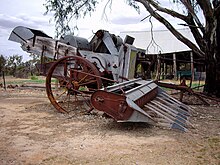
 The combine harvester, or simply combine, is a machine that harvests grain crops. The name derives from its combining three separate operations comprising harvesting—reapingthreshing, and winnowing—into a single process. Among the crops harvested with a combine are wheatoatsryebarleycorn (maize), sorghumsoybeansflax (linseed), sunflowers, and canola. The waste straw left behind on the field is the remaining dried stems and leaves of the crop with limited nutrients which is either chopped and spread on the field or baled for feed and bedding for livestock.

Combine harvesters are one of the most economically important labour saving inventions, significantly reducing the fraction of the population that must be engaged in agriculture
(Source:  https://en.wikipedia.org/wiki/Combine_harvester)


By Virtual Steve - Own work, CC BY-SA 2.5, https://commons.wikimedia.org/w/index.php?curid=1695653


By Kowloonese - Own work, CC BY 3.0, https://commons.wikimedia.org/w/index.php?curid=13269698

DIGITAL MEDIA IS A CONNECTION AND COMBINATION OF FORM AND FUNCTION FOR COMMUNICATION AND INFORMATION JUST AS THE COMBINE CONNECTED AND COMBINED SEVERAL FUNCTIONS INTO ONE FOR AGRICULTURE

FOR DIGITAL MEDIA - PRINT, AUDIO AND VIDEO ARE CONNECTED AND COMBINED INTO ONE DEVICE.  FOR THE COMBINE, REAPING, THRESHING AND WINNOWING WERE CONNECTED AND COMBINED INTO ONE DEVICE.

A person using a smartphone to take a digital photograph.
By Mueller / MSC, CC BY 3.0 de, https://commons.wikimedia.org/w/index.php?curid=30975746

The connections are made one by one, but they also are layered upon one another, and combined with other networks, creating hybrids that, like biological hybrids, have different characteristics than the original, creating new and revolutionary possibilities.


One way that we can prepare for an unknown future is to make computer simulated projections.  Researchers are doing this with hurricanes using data on past and present hurricanes:

Here is a link to a scientific journal paper titled  “An Analysis of the Effect of Global Warming on the Intensity of Atlantic Hurricanes Using a GCM with Statistical Refinement”  The paper was written by Ming Zhao
University Corporation for Atmospheric Research, Boulder, Colorado, and NOAA/Geophysical Fluid Dynamics Laboratory, Princeton, New Jersey and Isaac M. Held
NOAA/Geophysical Fluid Dynamics Laboratory, Princeton, New Jersey and published online December 1, 2010:  http://dx.doi.org/10.1175/2010JCLI3837.1


The paper explains how, using past and present data, simulation models can be constructed that will allow scientists to predict the effect of global warming as far in the future as the end of the 21st century.  

One way to answer the concern posed by Wheeler about the unknown future of communication networks would be to do computer simulated projections, using known data, and extrapolating that data into the future using projections of the future, such as various demographics (population, economics, and social trends), perhaps including data on global warming.

One of the connections required for modern communication technology is electricity.  Here is a link to a PBS Newshour transcript of a story about the future of fusion.  Fusion carries the promise of providing cheap electricity while leaving a minimal environmental footprint:
 

Researchers, peering into the future of communications technology, will look at the future of energy, like fusion.  Fusion and other innovations of the future will allow the communications revolution to continue to advance and accelerate into the future.  Fusion, as an energy source, may well be useful in a computer simulated projection into the future of communication technology.


 By analyzing past and present networks and making projections into the future, perhaps we can glean information about what to expect from the past and current convergence of media communication and related technology.  Dare we look as far as the end of the 21st century?  Perhaps we should, with the speed and fury of a hurricane.

Here are the links to the class readings for the week:

The Future of News--How the BBC is thinking about its future

The Web is Dead. Long Live the Internet (Wired Magazine)
http://www.wired.com/magazine/2010/08/ff_webrip/
TV and the Web (This is a TED Talk video)
http://www.ted.com/talks/peter_hirshberg_on_tv_and_the_web.html

How the Internet will (one day) transform government (this is a TED Talk video)
http://www.ted.com/talks/clay_shirky_how_the_internet_will_one_day_transform_government.html


Thursday, January 12, 2017

A BIT ABOUT ME

Hi, I’m Eulas Kirtdoll Sr.  I am currently a graduate student enrolled in the Strategic Communications program at Troy University.  Go Trojans!!!

UNDERGRADUATE IN HISTORY


I am grateful to be learning about how communications works in the world today.  My undergraduate degree is in History.  Learning about history taught me about the past, but more importantly, how important the past is to the present and the future.  Historians seek to understand the past, to interpret it, and to keep it alive in our memories.  After all, everything is in the past, except the present moment, and the unlived future.  And where would we be without memories and memory? 

COMMUNICATIONS AND HISTORY


Studying communication for me, therefore, is a paradigm shift.  But not a total shift away from history.  I am blending the two, realizing that much of what we communicate about is also history.  In fact, communications has a rich history itself.  This week in class we are focusing on the decline of print hard copy newspapers.  To understand the decline of newspapers you have to know some newspaper history.  In our class discussions I have talked about how newspapers may be dying to some extent, but their actual death is “greatly exaggerated” to quote Mark Twain’s famous reply to those who thought he was already dead.

Newspapers have done a great service to the world and to the USA.  Our founding fathers understood their importance when they made freedom of the Press one of our constitutional rights.  It was the Press that exposed Nixon’s Watergate scandal, and it will, no doubt, fall to the Press to investigate and reveal important scandals today and in the future involving government officials.  Our democracy is strong because of a free press.  Journalist have a lofty calling, and in my estimation, are under appreciated. 

The internet has made everyone a potential citizen journalist.  I applaud this because it truly democratizes the press.  But it also unlocks the potential for fraud and misinformation to run rampant.

  NO MAN IS AN ISLAND


"No man is an island" (John Donne, England 1624).  Each of us is connected to others  in some way.  
JohnDonne.jpg
John Donne - Age 42 - Source -  Wikipedia

Our interconnectedness is our communication.  Through communication we interact.  Communication is much more than words.  It is any act, or action that directly or indirectly either involves or is observed by another human being, or even an animal.  Communication can be passive or active.  

THE FALLING TREE IN THE FOREST


The tree that falls in the forest is heard whether anyone "hears" with their ears or not.  The tree's fall changes the life of the tree.  The amount of oxygen that the tree produces is affected.  As we have seen with global warming and climate change, we are all connected, and the oxygen from even one tree contributes to the aggregate of oxygen in the atmosphere, however minutely.  The communication from the tree is not just the sound of falling, it is even more importantly, the resultant change in the atmosphere when the tree dies and is no longer contributing to the oxygen content of the atmosphere.  So the falling of a tree, while not heard if outside of hearing range, still makes a difference.  My point?  Communication is not all hearing.  Communication is not all verbal, or in writing.  Communication is action.  The proverbial saying rings true:  Actions speak louder than words.


All of us are communicators and make a "statement" whether it is heard or not, seen or not.  The space we occupy, the air we breathe, all communicate our existence.  Ultimately, all communication attests to existence.  Communication is the manifestation of existence. Without existence we could not communicate.  And even if we live alone on an island, we communicate our existence without words, with each breathe.  Some of us are passive communicators, and others are active communicators.  Some of us are strategic communicators.  

I WANT TO COMMUNICATE WITH YOU


Strategic communicators are aware that every act of communication has the potential to effect change, or reinforce the status quo.  In the interconnected world of today, how we learn about what is occurring in the world around us is through media.  None of us can be everywhere at all times. The media brings local, regional, national, and international news to use today almost instantly.  Often the news matters little to us.  At other times, it impacts us either directly or indirectly.  None of us can afford the luxury of being an island, communicatively.  The purpose of this blog is to talk about STRATEGIC communication, particularly, emerging media, which includes social media.  I want to inform you, interact with you, and learn from you.  In short, I want to communicate with you.  

Communicating strategically means to communicate with a focused goal or goals in mind.  The emergence of the internet, and mobile communication technology have made it possible for us to share across the waters that separate the islands of individuality we each represent, and collaborate and synergize around shared goals.  Together, we can help one another become excellent communicators, and use that communication strategically to reach our goals, because, no person is a communication island.


Thanks for reading and stay tuned for more.  Strategic Communications-Emerging Media is ON THE AIR!!  

A POEM TO CLOSE THE BLOG POST

Talk is cheap
Action is not
What you say
is often soon forgot

Talk and action
When they jive and jell
Make it easy for
Your plan to sell

Be consistent
In all you do
Talk and action
Are like one and two

Communication is Strategic when
The talk and action are going to blend

Please remember it’s not just what you say
But what you do that matters anyway

Happy Communicating!!!


Welcome to my new blog.  

Eulas Kirtdoll Sr.

January 12, 2017