Digital Media and Convergence
Connections and Combinations at Hurricane Speed!!!
BY EULAS KIRTDOLL SR
Hurricanes consist of winds, water, temperature, air
pressures and directions, and other factors, that, when they connect and
combine in an enabling way, produce the most powerful of storms on earth. Similarly, digital media communication today
consists of hardware, soft ware, wireless towers, satellites and a host of
other factors, that, when they connect and combine in an enabling way, produce
the most powerful storm of convergent communication networks ever seen to this
time. As a result we live in a time of
hyper communication.
Mr. Tom Wheeler is the current Chairman of the Federal
Communications Commission (FCC). Mr. Wheeler mentions in one of our reading for the class this week
his belief that communication networks themselves don’t have
the power. Instead it is the connections
enabled by the communication networks that carry the power. Here is a link to a brief biography of
Wheeler: https://www.fcc.gov/about/leadership/tom-wheeler
Commissioner Wheeler’s interest and understanding of history
is clearly revealed in some of his writings:
Chairman Wheeler wrote Take Command: Leadership Lessons
of the Civil War (Doubleday, 2000) and Mr. Lincoln's T-Mails: The
Untold Story of How Abraham Lincoln Used the Telegraph to Win the Civil
War (HarperCollins, 2006).
Cueva de las Manos (Spanish
for Cave
of the Hands) in the Santa Cruz province in Argentina

By Mariano - Own
work, CC BY-SA 3.0, https://commons.wikimedia.org/w/index.php?curid=265811
This week our readings focus on the convergence of digital
media. Wheeler’s writing gives us a
glimpse of the past, present, and potential future of communication
networks. We need to put the current
digital media conditions in historical context, in order to make sense of the
present and to think about the future.
Newspapers, television, and magazines are all adopting online and mobile
presences, converging once divergent media into the digital online and
increasingly mobile format. This
convergence reminds me of the great power unleashed when connections are made
by the many parts (networks) that comprise a hurricane.
"Few things in nature can compare to the destructive force of a hurricane. Called the greatest storm on Earth, a hurricane is capable of annihilating coastal areas with sustained winds of 155 miles per hour or higher, intense areas of rainfall, and a storm surge. In fact, during its life cycle a hurricane can expend as much energy as 10,000 nuclear bombs!" (Source: http://earthobservatory.nasa.gov/Features/Hurricanes/ )
Hurricane Isabel (2003) as seen from orbit during Expedition 7 of the International Space Station. The eye, eyewall, and surrounding rainbands, characteristics of tropical cyclones in the narrow sense, are clearly visible in this view from
space.
(SOURCE: https://en.wikipedia.org/wiki/Tropical_cyclone )

By Image courtesy of
Mike Trenchard, Earth Sciences & Image Analysis Laboratory , Johnson Space
Center. - http://earthobservatory.nasa.gov/NaturalHazards/view.php?id=12140,
Public Domain, https://commons.wikimedia.org/w/index.php?curid=625449
The parts that connect in a hurricane are the wind, water,
air and water temperature, pressure, land, type of land, and other factors that
influence all of the preceding, may of which are manmade, such as climate
change. The power in these connects is
unleashed when the connections combine in a conducive way. Just as the hurricane’s power is realized
when the connections are made between the parts, so communication networks are
enabled and their power unleashed by the connections between the networks.
In fact, in a hurricane, it is the connection and
combination of the energy sources in a hurricane that produces the new level of
power unleashed in a storm. Similarly,
communication technology networks each have energy stored that is unleashed in
connection and combination, taking the energy in directions of heightened
power, and causing that power to be spread in a spatially multidirectional way.
Combine harvesters are one of the most
economically important labour saving inventions, significantly reducing the
fraction of the population that must be engaged in agriculture
(Source:
https://en.wikipedia.org/wiki/Combine_harvester)
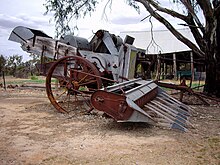
By Virtual Steve -
Own work, CC BY-SA 2.5, https://commons.wikimedia.org/w/index.php?curid=1695653

By Kowloonese - Own
work, CC BY 3.0, https://commons.wikimedia.org/w/index.php?curid=13269698
DIGITAL MEDIA IS A CONNECTION AND COMBINATION OF FORM AND
FUNCTION FOR COMMUNICATION AND INFORMATION JUST AS THE COMBINE CONNECTED AND COMBINED
SEVERAL FUNCTIONS INTO ONE FOR AGRICULTURE.
FOR DIGITAL MEDIA - PRINT, AUDIO AND VIDEO ARE CONNECTED
AND COMBINED INTO ONE DEVICE. FOR THE
COMBINE, REAPING, THRESHING AND WINNOWING WERE CONNECTED AND COMBINED INTO ONE
DEVICE.
A person using a
smartphone to take a digital photograph.

By Mueller / MSC, CC
BY 3.0 de, https://commons.wikimedia.org/w/index.php?curid=30975746
The connections are made one by one, but they also are
layered upon one another, and combined with other networks, creating hybrids
that, like biological hybrids, have different characteristics than the original,
creating new and revolutionary possibilities.
One way that we can prepare for an unknown future is to make
computer simulated projections. Researchers
are doing this with hurricanes using data on past and present hurricanes:
Here is a link to a scientific journal paper titled “An Analysis of the Effect of Global Warming
on the Intensity of Atlantic Hurricanes Using a GCM with Statistical Refinement” The paper was written by Ming Zhao
University Corporation for Atmospheric Research, Boulder, Colorado, and NOAA/Geophysical Fluid Dynamics Laboratory, Princeton, New Jersey and Isaac M. Held
NOAA/Geophysical Fluid Dynamics Laboratory, Princeton, New Jersey and published online December 1, 2010: http://dx.doi.org/10.1175/2010JCLI3837.1
University Corporation for Atmospheric Research, Boulder, Colorado, and NOAA/Geophysical Fluid Dynamics Laboratory, Princeton, New Jersey and Isaac M. Held
NOAA/Geophysical Fluid Dynamics Laboratory, Princeton, New Jersey and published online December 1, 2010: http://dx.doi.org/10.1175/2010JCLI3837.1
The paper explains how, using past and present data,
simulation models can be constructed that will allow scientists to predict the
effect of global warming as far in the future as the end of the 21st
century.
One way to answer the concern posed by Wheeler about the
unknown future of communication networks would be to do computer simulated
projections, using known data, and extrapolating that data into the future
using projections of the future, such as various demographics (population,
economics, and social trends), perhaps including data on global warming.
One of the connections required for modern communication
technology is electricity. Here is a
link to a PBS Newshour transcript of a story about the future of fusion. Fusion carries the promise of providing cheap
electricity while leaving a minimal environmental footprint:
Researchers, peering into the future of communications
technology, will look at the future of energy, like fusion. Fusion and other innovations of the future
will allow the communications revolution to continue to advance and accelerate
into the future. Fusion, as an energy
source, may well be useful in a computer simulated projection into the future
of communication technology.
By analyzing past and
present networks and making projections into the future, perhaps we can glean
information about what to expect from the past and current convergence of media
communication and related technology.
Dare we look as far as the end of the 21st century? Perhaps we should, with the speed and fury of
a hurricane.
Here are the links to the class readings for the week:
The Future of News--How the BBC
is thinking about its future
The Web is Dead. Long Live the
Internet (Wired Magazine)
http://www.wired.com/magazine/2010/08/ff_webrip/
http://www.wired.com/magazine/2010/08/ff_webrip/
TV and the Web (This is a TED
Talk video)
http://www.ted.com/talks/peter_hirshberg_on_tv_and_the_web.html
http://www.ted.com/talks/peter_hirshberg_on_tv_and_the_web.html
Long Live the Web
http://www.cs.virginia.edu/~robins/Long_Live_the_Web.pdf
http://www.cs.virginia.edu/~robins/Long_Live_the_Web.pdf
How the Internet will (one day)
transform government (this is a TED Talk video)
http://www.ted.com/talks/clay_shirky_how_the_internet_will_one_day_transform_government.html
http://www.ted.com/talks/clay_shirky_how_the_internet_will_one_day_transform_government.html
Nielsen changing the way it
measures television consumption
http://www.latimes.com/entertainment/envelope/cotown/la-et-ct-nielsen-20130221,0,7681633.story
http://www.latimes.com/entertainment/envelope/cotown/la-et-ct-nielsen-20130221,0,7681633.story
Newspapers can’t merely dabble
at digital
http://newsosaur.blogspot.com/2014/07/newspapers-cant-merely-dabble-at-digital.html
http://newsosaur.blogspot.com/2014/07/newspapers-cant-merely-dabble-at-digital.html

No comments:
Post a Comment